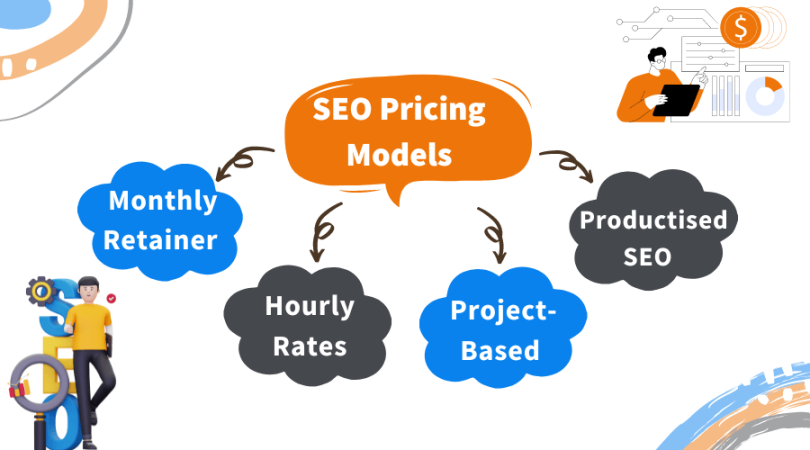

SEO providers structure pricing in several distinct ways, and the right model depends heavily on the nature of the work being done, not just budget preference. Understanding what each structure actually incentivizes helps avoid a mismatch between how a provider is paid and what a business actually needs from the engagement.
Monthly Retainers Suit Ongoing, Open-Ended Work
A retainer model, where a fixed monthly fee covers an agreed scope of ongoing work, fits SEO well because much of the discipline is continuous rather than a one-time deliverable — content production, link building, technical monitoring, and reporting all benefit from sustained effort rather than a single project. The risk with retainers is scope creep in either direction: a provider doing less than expected for the fee, or a business expecting unlimited work for a fixed price. Clear scope documentation at the outset prevents most disputes here.
Project-Based Pricing Works for Discrete, Well-Defined Work
A technical audit, a site migration review, or a one-time content strategy overhaul are naturally suited to project pricing, since the deliverable is clearly bounded and doesn’t require ongoing management. Project pricing tends to be more predictable for both sides but doesn’t fit ongoing tactics like link building well, since those require sustained activity rather than a single deliverable.
Performance-Based Pricing Sounds Appealing but Carries Real Risk
Paying only for ranking improvements or traffic gains seems like it aligns incentives perfectly, but it often pushes providers toward whatever tactic moves the needle fastest, which isn’t always the safest or most sustainable choice for the client’s long-term interests. It can also create disputes over attribution, since ranking changes have multiple contributing causes and isolating the provider’s specific contribution is often genuinely ambiguous.
Hybrid Models Are Increasingly Common
A base retainer covering core ongoing work, combined with a smaller performance bonus tied to clearly defined, mutually agreed metrics, balances predictability with some incentive alignment without pushing a provider toward reckless tactics purely to hit a bonus threshold. This structure requires more upfront negotiation to define metrics fairly but tends to produce a healthier long-term relationship than a pure performance model.
Questions Worth Asking Regardless of Model
Whatever the pricing structure, clarity matters more than the model itself: what specifically is included in the fee, what counts as additional scope requiring separate billing, how often reporting happens, and what the cancellation terms are if the relationship isn’t working. Providers offering SEO Services with genuinely clear answers to these questions, regardless of which pricing model they use, are generally easier to work with than ones whose pricing structure obscures what’s actually being delivered.
The cheapest pricing model on paper isn’t necessarily the best value if it incentivizes the wrong behavior or leaves scope ambiguous enough to generate disputes later. Matching the pricing structure to the actual nature of the work — ongoing versus discrete, predictable versus results-dependent — tends to produce a more stable, productive relationship than choosing based on the headline number alone.