
When concrete repair, waterproofing, and surface protection are specified as separate activities, performance gaps often emerge between them. Concrete may be repaired correctly, but remain exposed to moisture ingress. Waterproofing may be installed, but over a substrate that continues to deteriorate. GRP laminates may be considered late in the process rather than as part of an integrated protection strategy. The result is often a cycle of recurring defects, not because the products are ineffective, but because they were never designed to work together as a complete system.
That cycle of repair, fail, repair again is common enough in building maintenance that it’s worth understanding what breaks it. The answer usually involves looking at what’s happening beneath the visible damage before deciding how to treat the surface.
Concrete Deterioration And Why Surface Repairs Keep Failing
Concrete in the UAE faces an aggressive combination of conditions. Thermal cycling from extreme daytime heat to cooler nights stresses the material repeatedly over years. Chloride penetration from coastal air attacks reinforcement steel, compounded in parking structures by vehicle-tracked salt and cleaning chemicals. Carbonation works its way inward over time, reducing the alkalinity that protects the rebar.
Surface concrete repairs applied without addressing these underlying processes are working against the clock. A patch that fills a crack or restores a spalled section but doesn’t slow chloride ingress or arrest the carbonation front will be undermined from within. The repair looks complete while the deterioration continues underneath it.
Getting concrete repair right in this environment means going further than the visible damage, which encompasses testing the depth of contamination, assessing the condition of the reinforcement, and choosing repair mortars and coatings that address the specific mechanism driving the deterioration, not just the symptom showing at the surface.
Waterproofing As Part Of The Repair System, Not An Afterthought
One of the more persistent errors in building remediation is treating waterproofing as a separate operation from the structural repair, fixing the concrete first, then applying a coating over the top as a final protective layer. In practice, the two need to be designed as a system.
A waterproofing membrane applied over repaired concrete that still has active cracks or inadequate bond will fail at those points first: water finds edges, discontinuities, and areas where preparation fell short. The same product behaves completely differently depending on whether the substrate was properly dealt with first.
For exposed horizontal surfaces, parking decks, roof slabs, and terraces, the waterproofing system also needs to account for the thermal and mechanical movement the structure will experience. A rigid coating over a substrate that moves will crack. A system designed around that movement, with appropriate flexibility and detailing at joints and transitions, holds.
Where GRP Laminates Change The Performance Equation
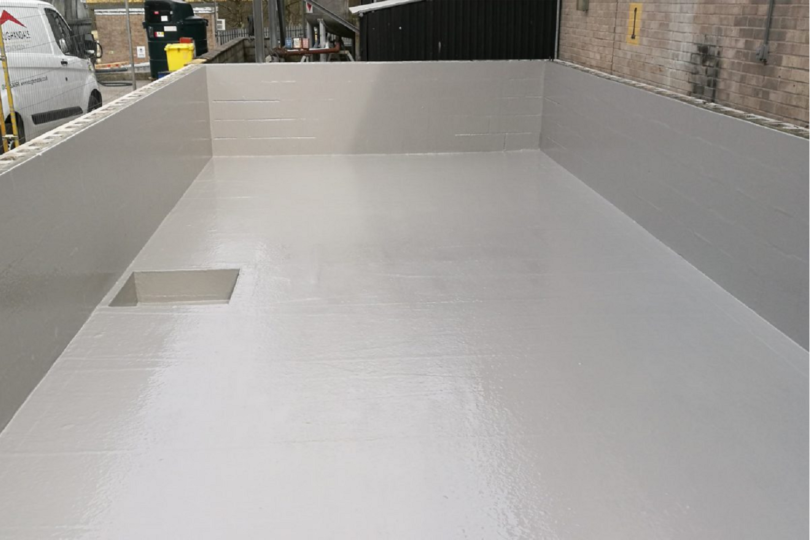
For applications where durability under sustained mechanical and environmental load is the priority, GRP laminates offer a different order of performance from conventional coating systems. The glass fibre reinforcement creates a composite layer that distributes load, bridges minor substrate movement, and resists the kind of abrasion and impact that would damage thinner membrane systems.
In parking decks, industrial floors, plant room areas, and roof structures carrying foot or vehicle traffic, GRP laminates have been used where repeated mechanical stress would degrade conventional waterproofing systems within a few seasons. The installation requires more preparation and more skilled application than a simple coating; the substrate needs to be sound, the laminate needs to be properly consolidated, and the detailing at edges and penetrations needs to be executed carefully.
The performance difference justifies the additional investment on surfaces where the consequence of failure is high and the access for remediation is difficult or disruptive. On a sheltered internal surface with light use, a simpler system performs adequately. GRP isn’t the right answer everywhere, and specifying it where it isn’t needed doesn’t improve anything.
Reading The Substrate Before Choosing The System
The most successful repair and protection strategies begin with understanding the condition of the substrate, the mechanisms driving deterioration, and the long-term performance requirements of the structure. Only then can the appropriate combination of concrete repairs, waterproofing systems, and GRP laminates be selected.