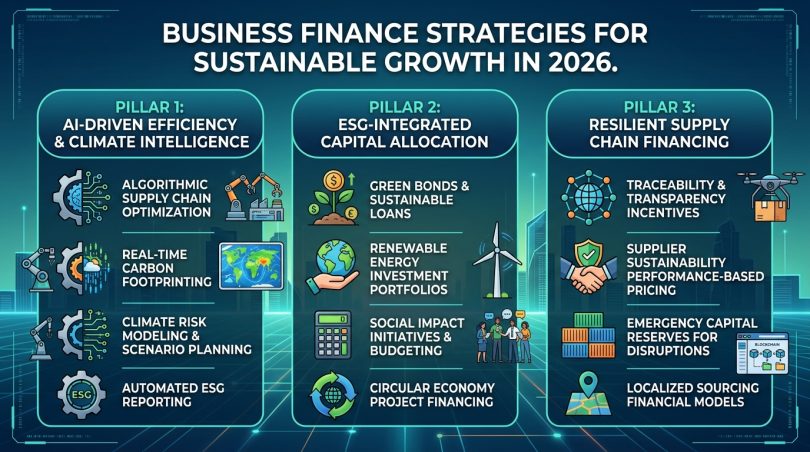

Business finance is the backbone of every successful company, helping organizations manage money, investments, and operational costs efficiently. In 2026, businesses are facing new financial challenges due to inflation, digital transformation, and global market competition. At the same time, new opportunities are emerging through fintech, automation, and global expansion. Understanding modern business finance strategies is essential for sustainable growth and long-term stability.
Importance of Financial Planning in Business
Financial planning is the foundation of any successful business. It helps companies allocate resources effectively, manage expenses, and ensure profitability. Without proper planning, businesses often struggle with cash flow issues and unexpected financial risks.
In 2026, financial planning has become more data-driven. Businesses now use advanced tools and software to forecast revenue, analyze spending patterns, and make smarter financial decisions. This reduces risk and improves overall financial performance.
Cash Flow Management Strategies
Cash flow management is critical for maintaining business stability. It ensures that a company has enough liquidity to cover daily operations, salaries, and expenses. Poor cash flow management is one of the leading causes of business failure.
Modern businesses are now using automated accounting systems to track cash flow in real time. This allows them to identify financial gaps early and take corrective action before problems arise.
Investment Planning for Business Growth
Investment plays a key role in expanding business operations. Companies invest in technology, infrastructure, marketing, and human resources to grow their market presence. Smart investment decisions can significantly increase profitability.
In 2026, businesses are focusing more on digital investments such as AI tools, cloud systems, and automation software. These investments help reduce costs and improve efficiency in the long run.
Cost Reduction and Efficiency Improvement
Reducing unnecessary costs is an important part of business finance. Companies continuously look for ways to optimize operations and eliminate wasteful spending. This improves profit margins and financial stability.
Outsourcing, automation, and digital tools are now widely used to reduce operational costs. Businesses that adopt these strategies can achieve higher efficiency with lower expenses.
Role of Technology in Business Finance
Technology is transforming the way businesses manage their finances. From cloud accounting to AI-based financial analysis, companies now have access to powerful tools that simplify financial management.
These technologies provide real-time insights into business performance, helping managers make faster and more accurate decisions. This has made financial management more efficient and transparent.
Risk Management in Business Finance
Every business faces financial risks such as market fluctuations, inflation, and unexpected expenses. Risk management helps companies prepare for these uncertainties and minimize potential losses.
Businesses now use predictive analytics and financial modeling to identify risks early. This allows them to create backup plans and maintain financial stability even during uncertain times.
Funding and Capital Management
Funding is essential for starting and expanding a business. Companies raise capital through loans, investors, or internal profits. Proper capital management ensures that funds are used effectively for growth.
In 2026, alternative funding options such as crowdfunding and venture capital are becoming more popular. These options provide businesses with flexible financial support without traditional banking restrictions.
Financial Reporting and Transparency
Financial reporting is important for tracking business performance and maintaining transparency. It includes income statements, balance sheets, and cash flow reports.
Accurate financial reporting helps businesses build trust with investors and stakeholders. It also ensures compliance with legal and regulatory requirements.
Future of Business Finance
The future of business finance is heavily influenced by digital transformation. Artificial intelligence, blockchain, and automation are expected to play a major role in financial operations.
These technologies will make financial systems more efficient, secure, and transparent. Businesses that adapt early will have a competitive advantage in the market.
FAQs
What is business finance
Business finance refers to managing money, investments, and financial resources in a company.
Why is financial planning important for businesses
It helps businesses manage resources efficiently and avoid financial risks.
How does technology help in business finance
Technology improves accuracy, automation, and real-time financial decision-making.
What are common financial risks in business
Market changes, cash flow issues, and unexpected expenses are common risks.
What is the future of business finance
It is moving toward automation, AI-driven analysis, and digital financial systems.
Conclusion
Business finance in 2026 is evolving rapidly due to technological advancements and global economic changes. Companies that focus on smart financial planning, cost efficiency, and digital transformation are more likely to succeed. With proper strategies and risk management, businesses can achieve long-term stability and sustainable growth in an increasingly competitive market.